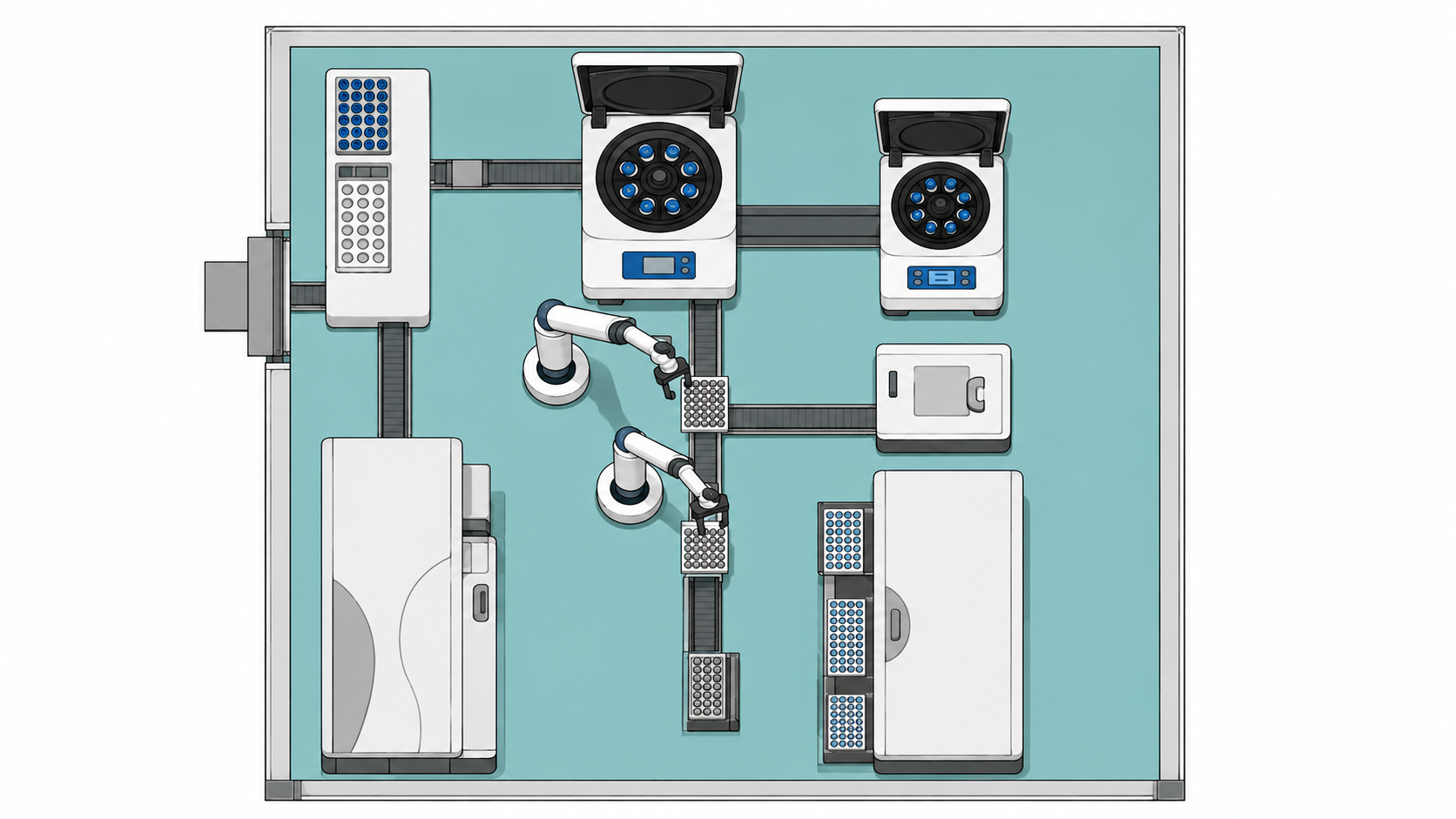
Automation has been part of laboratory life for decades, from robotic pipetting to total laboratory automation lines. The question now is what AI in lab automation adds on top. Three recent papers give a grounded answer: it is promising, and it is still early.
AI in lab automation is arriving, with caveats
An opinion paper from the European Federation of Clinical Chemistry and Laboratory Medicine (EFLM) notes that lab processes are modular, which makes them a good fit for AI. It also points out that most medical AI research focuses on radiology, surgery and oncology, with far less attention on laboratory medicine. The authors argue that AI models should be judged on robustness, interpretability and real clinical usefulness, not accuracy alone, because models that perform well at the institution that built them can lose accuracy elsewhere.
Where AI in lab automation is already working
A 2026 scoping review of 22 studies looked at AI-supported digital microscopy in primary care laboratories. Across targets such as malaria, intestinal parasites, cervical and oral cell changes and urinalysis, AI systems reached accuracy comparable to standard methods. In six of seven studies that allowed the comparison, they were also more sensitive than manual microscopy. Sample-to-answer times were typically around 20 to 40 minutes.
The review is candid about the limits. Manual sample preparation introduces variability that can hurt AI performance. Training data is scarce. Many studies were small. Cost and scalability still need proper evaluation. Human verification of AI findings also made a difference: in one malaria study it improved specificity substantially with almost no loss of sensitivity.
What comes next: agentic AI in lab automation
A recent opinion from the IFCC Division on Emerging Technologies looks further ahead, at “agentic” AI. Rather than just predicting or flagging, these systems could plan and carry out multi-step tasks, such as checking a test request, routing a specimen, validating a result and drafting a report. The authors stress that this remains largely conceptual. Some of the examples they cite are preprints needing independent validation. Their own practical example, cutting unnecessary thyroid hormone tests by 40 to 60 per cent, was achieved with a conventional rule-based approach, not agentic AI. They recommend starting small with targeted tasks like test stewardship, and keeping humans in the loop with audit trails and clear accountability.
The common thread
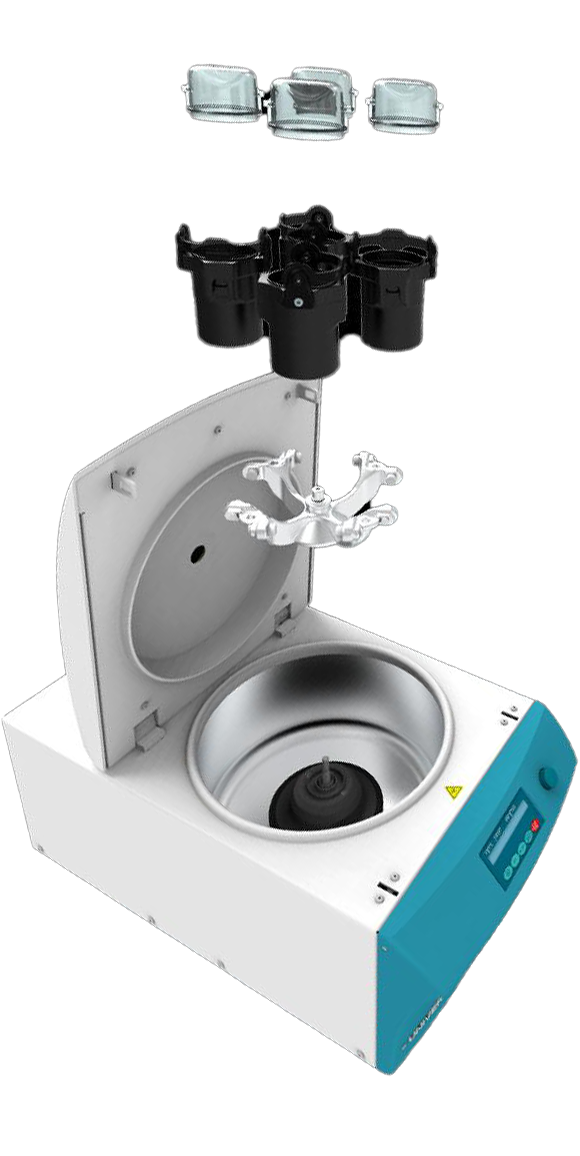
All three papers reach the same conclusion. AI in lab automation is only as good as the processes, data and equipment beneath it, and it works best when people stay involved. Validation, quality control, consistent sample handling and well-maintained instruments are what make automated results trustworthy. That starts with dependable hardware, such as automated centrifuges backed by proper servicing and support
Why collaboration matters for AI in lab automation
None of this can be done by one party alone. The EFLM authors describe partnership between laboratories, clinicians, data scientists and industry as a professional competency that labs will need to build. The scoping review calls for multi-site collaboration and data sharing to overcome small datasets. The agentic AI paper calls for interdisciplinary governance so that autonomy does not outpace accountability.
For laboratories, that means working closely with the people who supply, validate, calibrate and service their equipment, as well as with software and data specialists. Automated centrifuges are a good example. They sit at the heart of many automated workflows, and any AI or software layer that schedules, tracks or monitors samples depends on them running reliably and performing to specification. The labs that benefit most from AI in lab automation will likely be the ones that build these partnerships early, so that new technology is introduced on a foundation of reliable, well-supported systems.
At Henderson Biomedical, we are all about collaboration, and quality is at the heart of everything we do. As the UK’s exclusive partner and service provider for Hettich automated centrifuges, we work alongside laboratories to keep their equipment supported, calibrated and performing as it should, helping them maintain the highest standards of quality. Whether you are planning to bring AI in lab automation into your workflow or want to get more from the equipment you already have, we would like to work with you.
Reach us at info@henderson.biomedical.co.uk or 0208 663 4610.