Service and Digital Technician with a background in automation and control. An engineering mind with a creative twist, I’m all about blending technology, people and forward-thinking strategy. Big believer in always doing things better!
Share Post:
Choosing the right centrifuges is not just about speed or capacity, it is about finding the instruments that fit seamlessly into your workflow, your sample types, and your throughput demands. With so many models on the market, the decision can feel overwhelming.
This guide cuts through the complexity. Below, we match five key centrifuge models to the laboratories where they perform best, and explain exactly why each one excels in that environment.
Quick Selection Guide
Not sure where to start? Use this rule of thumb before diving deeper:
Mostly 0.2–2 mL tubes → microcentrifuge (e.g. the Hettich MIKRO 220 or MIKRO 220R depending on whether refrigeration is needed).
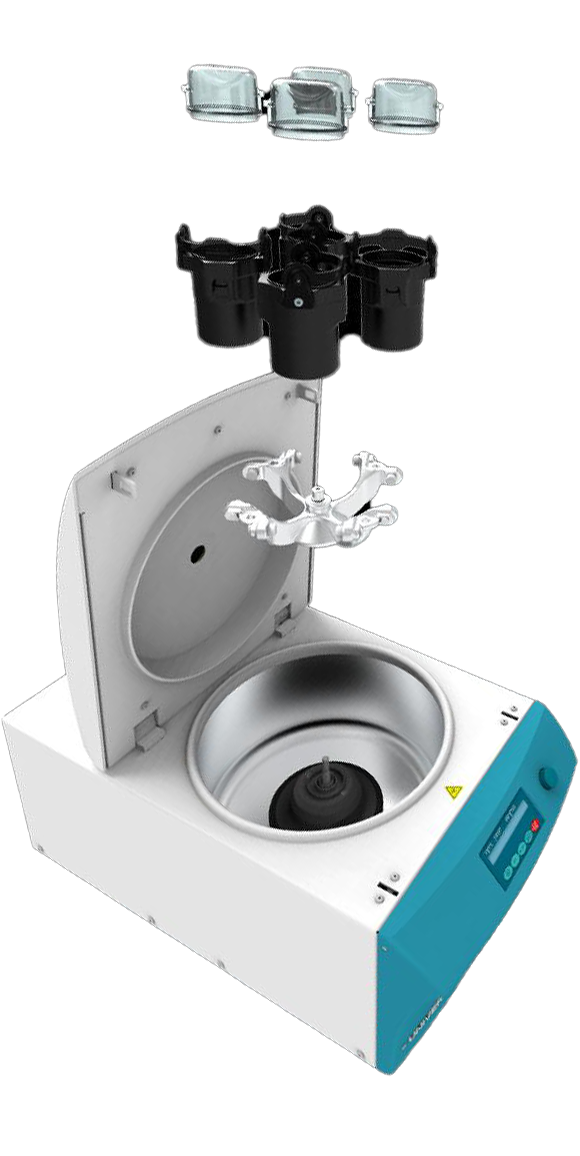
15 and 50 mL conical tubes or blood collection tubes → benchtop general-purpose centrifuge, usually with a swing out rotor, buckets and adaptors (e.g the Hettich UNIVERSAL 320 or UNIVERSAL 320R depending on whether refrigeration is needed).
Temperature-sensitive samples → refrigerated model (usually signified with the R-suffix variant).
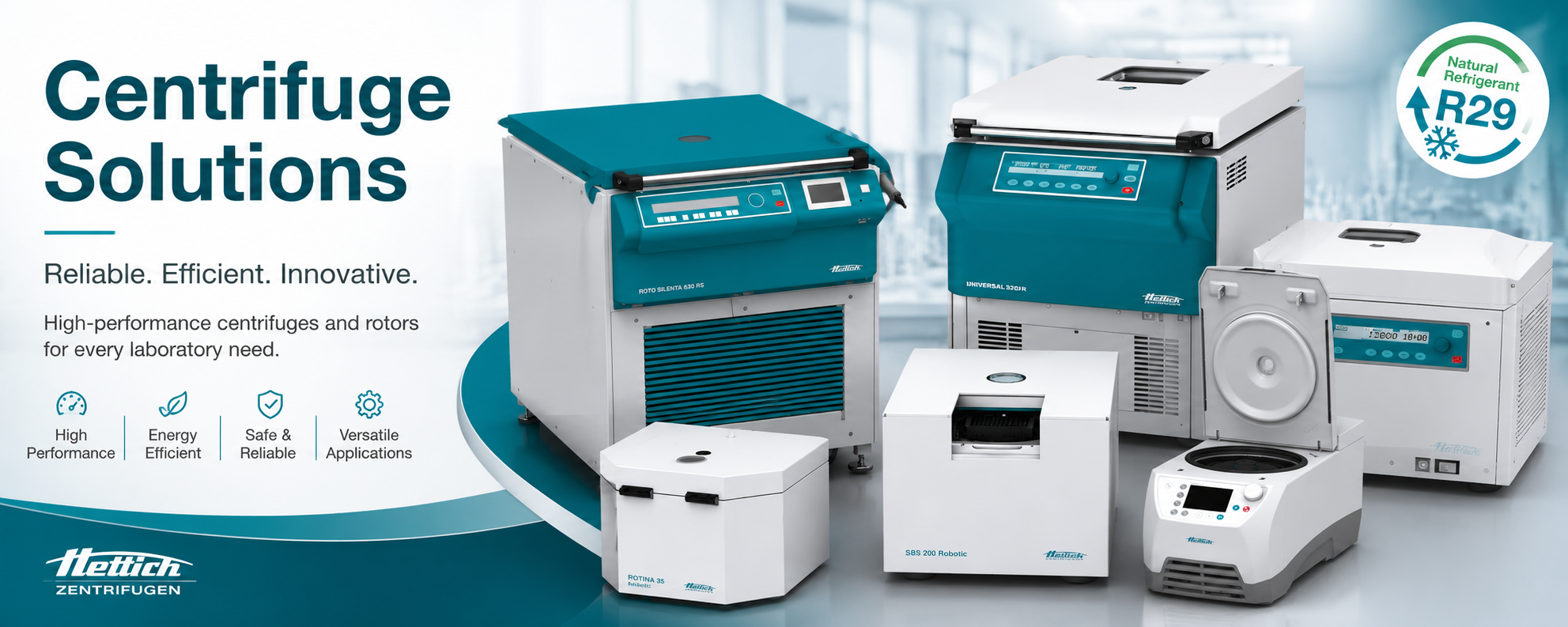
High volumes in the litre range or blood bags→ floor-standing centrifuge (e.g. the Hettich ROTO SILENTA 630 RS).
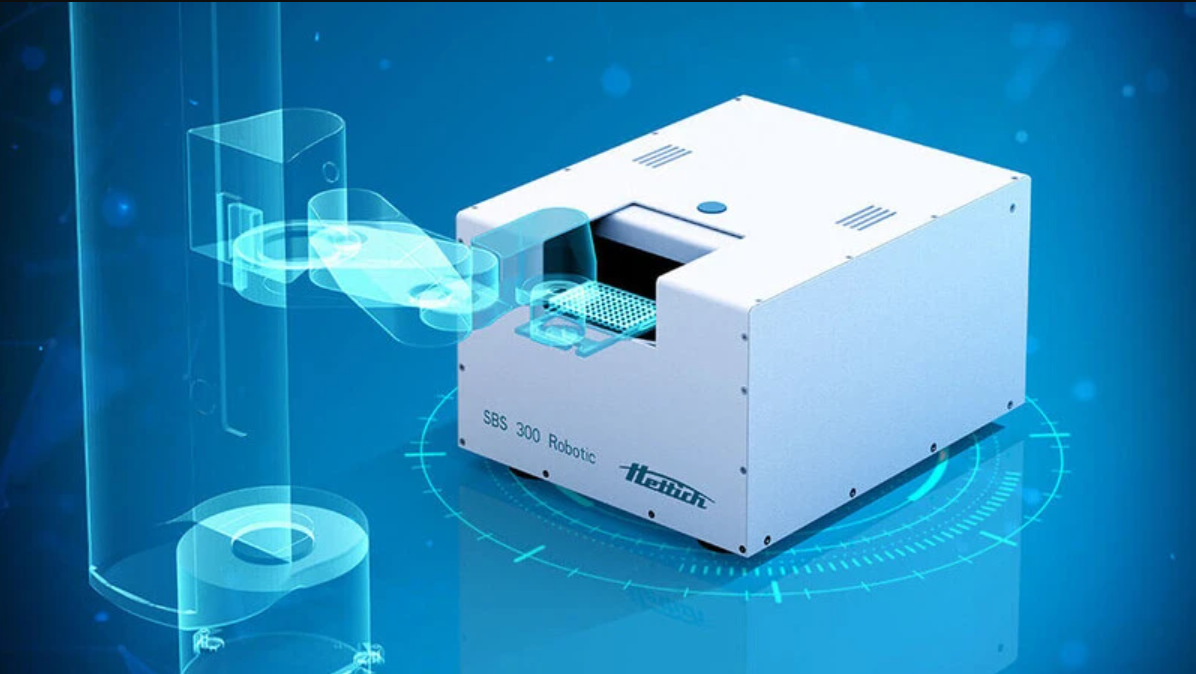
Hundreds of samples per day in an automated line → robotic centrifuge (e.g. the Hettich SBS 300 or SBS 300R)
At a Glance: Centrifuges–Laboratory Match
Centrifuge Model
Best-Fit Lab
Why It Fits
Typical Applications
MIKRO 220 / 220 R
Molecular Biology / PCR / Genetics Lab
Highest RCF (31,514 ×g) in a compact footprint. Ideal for small-volume, high-speed separations.
Built for robotic integration. Processes hundreds or thousands of samples automatically.
Automated sample prep, clinical automation lines, drug discovery, biobanking
ROTO SILENTA 630 RS
Blood Bank / Transfusion Centre / Industrial Biotech
Floor-standing, large-capacity design for litre-scale volumes. Up to 12 blood bags per run.
Blood bag processing, plasma prep, cell culture harvesting, large-volume separation
1. Molecular Biology, Genetics & PCR Laboratories
Best match: MIKRO 220 / MIKRO 220 RCentrifuges
Molecular biology laboratories demand extreme centrifugal force in a small footprint. Samples are typically processed in 0.2–2.0 mL microtubes, and the priority is achieving clean, high-speed separations, whether that means pelleting nucleic acids, clarifying lysates, or spinning down PCR reagents.
The MIKRO 220 delivers a maximum RCF of 31,514 ×g, the highest in its class of compact centrifuges. With eight rotor options and a refrigerated variant (the MIKRO 220 R) reaching down to −20°C, it keeps temperature-sensitive enzymes and nucleic acid extracts stable throughout the run.
Key applications:
DNA and RNA extraction
PCR tube preparation and reagent clarification
Protein precipitation
Microbial analysis and forensic sample preparation
Molecular diagnostics
2. Clinical Molecular Diagnostics, Biotechnology & Academic Research
Best match: MIKRO 2.0 / MIKRO 2.0 RCentrifuges
Where the MIKRO 220 prioritises raw speed, the MIKRO 2.0 brings the next generation of usability to molecular workflows. It reaches a maximum of 25,212 ×g, still well within the range required for nucleic acid purification and PCR work, while adding features that make a meaningful difference in a busy laboratory environment.
NFC-based rotor recognition automatically identifies the installed rotor, reducing the risk of operator error and simplifying daily use. The LCD display and push-turn control interface allow rapid programme recall, and full refrigeration to −20°C ensures sample integrity for the most temperature-sensitive assays.
This model is particularly well suited to clinical molecular diagnostics settings, where reliability, traceability, and ease of use are as important as centrifugal performance.
Key applications:
PCR workflows and nucleic acid purification
Genetic testing and sequencing prep
Biochemistry and pharmaceutical research
Food safety and quality analysis
3. Hospital Clinical Laboratories & University Core Labs
Best match: UNIVERSAL 320 / UNIVERSAL 320 RCentrifuges
Clinical and university core laboratories do not have the luxury of running a single sample type. In a single morning, a hospital lab may need to process blood tubes, cell culture plates, cytology samples, and serology panels, sometimes all on the same instrument.
The UNIVERSAL 320 is built for exactly this environment. Its maximum RCF of 24,900 ×g is more than adequate for routine clinical separations, and its wide range of compatible rotors and accessories means it can handle virtually any vessel format in common laboratory use. Swing-bucket rotors accommodate standard blood collection tubes; angle rotors increase throughput for batch processing.
The refrigerated UNIVERSAL 320 R extends this flexibility to temperature-sensitive samples, while the capacity to hold up to 4 × 200 mL or 6 × 94 mL makes it one of the higher-volume benchtop options available.
Best match: SBS 300 / SBS 300 R RoboticCentrifuges
In high-throughput environments, large clinical automation lines, pharmaceutical screening facilities, and biobanks, the bottleneck is rarely the centrifuge speed. It is the manual loading and unloading of samples. Operators cannot keep pace with the volume, and human handling introduces variability.
The SBS 300 R is not a conventional benchtop centrifuge. It is engineered specifically for integration into robotic laboratory systems, where automated arms load and unload microplates or tubes without human intervention. This makes it the logical choice anywhere hundreds or thousands of samples must be processed consistently and reproducibly each day.
Key applications:
Automated sample preparation in clinical diagnostic lines
High-throughput drug discovery and pharmaceutical screening
Biobank sample processing
Any workflow where robotic integration is a requirement
Some applications simply outgrow the benchtop. Blood banks and transfusion centres routinely process blood bags containing hundreds of millilitres each, and large-scale cell culture operations may need to harvest litres of biomass in a single run. No compact or mid-range benchtop centrifuge can meet this demand.
The ROTO SILENTA 630 RS is a floor-standing refrigerated centrifuge capable of processing up to 6 × 2,000 mL per run, or with the appropriate rotor, up to 12 blood bags simultaneously. Its maximum RCF of 6,520 ×g is lower than benchtop models, but that is the correct trade-off when volume, not speed, is the primary requirement. Refrigeration to −20°C preserves the integrity of blood products and biologics throughout extended processing runs.
Key applications:
Blood bag processing and component separation
Plasma and platelet preparation for transfusion
Large-volume cell culture harvesting
Industrial and R&D biological separation
Litre-scale upstream and downstream bioprocessing
Choosing Confidently
The right centrifuge is the one that matches not just the science, but the scale, the sample type, and the workflow of your laboratory. A molecular diagnostics lab and a blood bank may both use centrifuges every day, but they need very different instruments to do so efficiently.
Use the quick selection guide at the top of this article as your starting point, then refer to the detailed sections to confirm your choice. If your laboratory spans multiple disciplines, a versatile model like the UNIVERSAL 320 R or a combination of a micro- centrifuges and a general-purpose unit may serve you best.
For personalised guidance, speak to one of our specialists who can assess your throughput, sample types, and automation needs before you invest. You can contact us using our online form or give us a call on 020 8663 4610.